UV Safety at Altitude: What Colorado Sun and Elevation Really Do to Your Skin and Hormones
Generic sun advice was not written for a body sitting a mile above sea level. At Lafayette's elevation, the same July afternoon delivers measurably more UV than it would at the coast — and skin already losing collagen to perimenopause has less margin for error. Here is what that actually means, and what to do about it
Last updated: June 2026
UV Safety Month usually arrives with the same recycled advice everywhere in the country: wear sunscreen, avoid peak sun, wear a hat. That advice isn't wrong, but it wasn't written for Lafayette, Colorado. It wasn't written for a body sitting a mile above sea level, and it certainly wasn't written for a woman whose skin is also navigating perimenopause or menopause at the same time. In my practice, I see both of these realities collide constantly, and neither one is optional information if you actually live here.
This post covers what elevation really does to UV exposure in Boulder County, why that intensity interacts differently with skin that's already losing collagen and elasticity from hormonal change, and what practical steps actually make a difference at 5,000-plus feet. As a family physician with Menopause Society Certified Practitioner (MSCP) credentialing, I sit at the intersection of both of these issues almost every week, whether it's a teenager coming in sunburned from a lake day or a patient in her late 40s asking why her skin suddenly feels thinner and more reactive than it did five years ago.
Why Colorado Sun "Hits Different": The UV Math at Elevation
There's a reason Colorado sun feels more intense than sun back east or at the coast, and it isn't just perception. The atmosphere thins as elevation increases, and a thinner atmosphere filters out less ultraviolet radiation before it reaches your skin.
According to the EPA, UV intensity increases about 6% per kilometer of elevation gain above sea level, a figure the agency builds directly into its daily UV Index forecasting model. Other researchers studying high-altitude UV exposure have found comparable or even steeper effects, with some estimates citing roughly a 12% increase in UV radiation for every 1,000 meters gained.
Lafayette sits around 5,200 feet. Denver, at roughly the same elevation, has been measured by University of Colorado dermatology researchers as having about 25% more ambient UV than an identical light level at sea level, with that figure climbing to roughly 50% more UV at 10,000 feet. That's not a mountain-town problem. That's a Front Range problem, and it applies to anyone running errands in Lafayette on an ordinary July afternoon.
A few other factors compound this:
Thinner air also means less atmospheric scattering to protect you in early morning or late afternoon light, so the "safe" window most people assume exists at lower elevations is shorter here.
Snow reflects a large share of UV back upward, which matters for anyone skiing, hiking, or working outdoors in shoulder-season snow.
Clear Colorado skies, which we have far more of than most states, transmit close to the full UV signal, unlike overcast climates that naturally block a portion of it.
Why This Matters More in Midlife: Skin, Hormones, and a Thinner Shield
This is the piece that generic sun-safety content almost never mentions, and it's the piece I think about constantly in my own practice. Skin doesn't respond to UV exposure the same way at every life stage, and perimenopause and menopause change the equation substantially.
Estrogen plays a direct role in collagen production and skin thickness. As estrogen declines, so does the skin's ability to make and retain collagen. Research first documented by Brincat and colleagues, and confirmed in more recent dermatology literature, found that skin collagen loss accelerates to roughly 2.1% per year in the years immediately following menopause, adding up to a cumulative loss of about 30% of skin collagen within the first five years.
What that means practically:
Thinner skin has less natural buffer against UV damage. A sunburn or cumulative UV exposure that a 30-year-old's skin absorbs and recovers from more easily can do proportionally more damage to skin that has already lost a meaningful share of its structural collagen.
Barrier function changes alongside hormones. Reduced estrogen also affects hydration and barrier integrity, which is part of why patients in perimenopause often describe their skin as suddenly more reactive, drier, or slower to bounce back after sun exposure.
Existing sun damage becomes more visible faster. Fine lines, uneven pigmentation, and laxity that were previously masked by more robust collagen reserves tend to surface more quickly once that reserve drops.
None of this means midlife skin is fragile or that damage is inevitable. It means the margin for error with UV exposure gets smaller precisely at the point in life when many women are also juggling the mental load of family, work, and health decisions for an entire household, which I've written about in the mental load women carry during the holidays, a similar pattern of an invisible burden nobody accounts for.
What Actually Changes at Altitude, Not Just in Theory
Colorado's elevated UV exposure isn't an abstract statistic. It shows up in real health outcomes across the state.
The Colorado Cancer Center at CU Anschutz has reported that Colorado has more skin cancer cases than many states specifically because of the combination of abundant sun and high altitude, since sun exposure is more intense and damaging at elevation. Statewide, Colorado researchers have found that Colorado has the nation's highest per-capita rate of skin cancer, a pattern attributed to the state's altitude, climate, and a largely fair-skinned, outdoor-oriented population.
Elevation-specific data backs this up further. The Colorado Health Institute found that mountain counties above 8,000 feet, including Pitkin, Gunnison, Garfield, Eagle, and Chaffee, report melanoma rates above 30 per 100,000 people, while Front Range counties under 6,000 feet, including Denver, report meaningfully lower rates around 15 to 20 per 100,000. Lafayette sits closer to the lower end of that range than the high mountain towns, but it is still measurably above sea-level baseline exposure, and cumulative exposure over decades matters more than any single summer.
Nationally, the American Academy of Dermatology reports that one in five Americans will develop skin cancer in their lifetime, with approximately 9,500 people diagnosed daily. Colorado's elevation doesn't change that baseline risk. It adds to it.
Practical Sun Protection for Boulder County Life
Sun safety advice doesn't need to be complicated, but it does need to be recalibrated for elevation. Here's what I actually recommend to patients living and raising families in Lafayette:
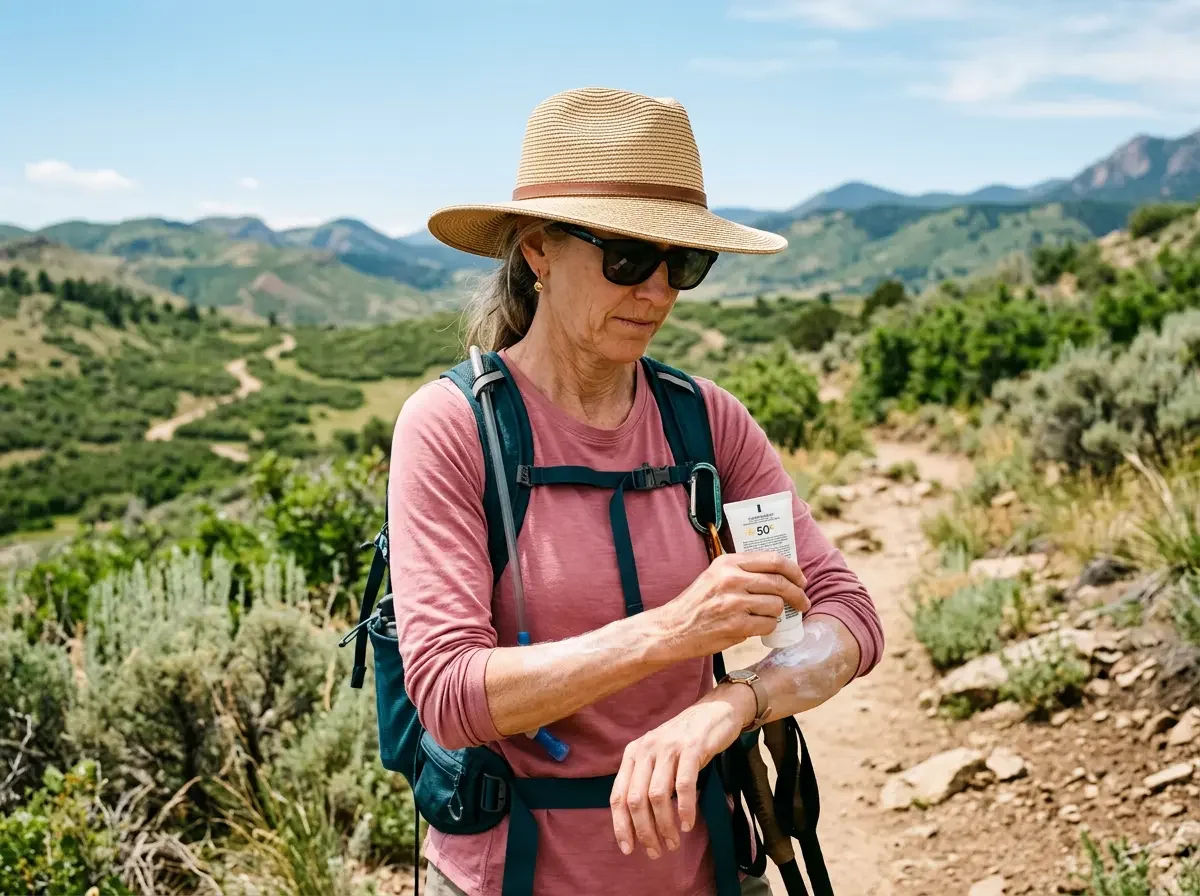
Reapply sunscreen more often than the label suggests. SPF 30 or higher, reapplied every two hours outdoors, matters more here than at sea level because UV intensity is simply higher for the same clock time spent outside.
Don't trust cloud cover as a shield. Colorado's high, thin cloud layers block far less UV than the denser cloud systems in other climates.
Protect eyes and scalp, not just skin. Sunglasses that block UVA and UVB, along with a wide-brimmed hat, matter more at elevation given the added intensity.
Reset the "safe window" assumption. The early morning and late afternoon hours that feel gentler at sea level still carry more UV here.
Treat snow season as sun season. Reflected UV off snow means ski days and winter hikes deserve the same sunscreen habits as July.
This isn't about fear. It's about matching effort to the actual physics of where you live, which is a theme I come back to often, including in how Colorado summers are genuinely harder on the body than people expect.
When Sun Damage and Hormonal Skin Changes Overlap
I recently had a conversation with a patient in her early 50s who assumed her increasingly dry, thin-feeling skin was simply "getting older." What we found, once we walked through her history together, was a combination of long-term high-altitude sun exposure from decades of Colorado living and a hormonal shift that was compounding it. Neither factor alone explained what she was seeing. Together, they did.
"I tell patients that Colorado sun and midlife hormones aren't two separate stories; they're one story," is something I find myself saying often in visits. "If we only address one, the skin changes a patient is noticing rarely make sense to her, because we're only explaining half the picture."
This is exactly the kind of connection a rushed 12-minute visit doesn't have time to make. It requires actually asking about sun history, family history, and hormonal timeline together, which is part of why I've written before about what a 60-minute visit finds that a 12-minute visit doesn't and why personalized menopause care built around unhurried time changes what actually gets caught.
If you're noticing new skin changes, whether that's increased dryness, slower healing, new spots, or skin that feels thinner than it used to, it's worth a real conversation rather than an assumption that it's simply age. The same is true if you've noticed other subtle hormonal shifts alongside it, like the patterns described in six lesser-known signs of hormonal change or the broader midlife metabolic shift many women aren't warned about.
What I'm Watching in Lafayette This Summer
UV Safety Month is a good annual reminder, but living at elevation means this isn't a once-a-year conversation. It's a daily physiological reality for anyone in Boulder County, and it becomes a slightly different conversation again once perimenopause or menopause enters the picture.
My approach with patients is straightforward: acknowledge that Colorado sun genuinely behaves differently than sun almost anywhere else in the country, take that seriously with real sun-protection habits, and pair it with an honest look at what's happening hormonally so we're not treating skin changes as a mystery. Sun protection helps manage long-term skin health and reduce skin cancer risk. It isn't a guarantee against either, and no responsible physician will tell a patient otherwise, but consistent habits meaningfully shift the odds in the right direction.
If you've noticed changes in your skin this summer, or you're simply trying to understand why Colorado sun feels so much more intense than it did somewhere else you've lived, that's a conversation worth having with a physician who understands both the altitude physiology and the hormonal picture. You can reach our office at 720-439-4002 or visit manifesthealthcm.com to learn more about care at Manifest Health Concierge Medicine in Lafayette.